8 Sneaky Budget Leaks Quietly Draining Your Bank Account

Your bank account has a hole in it.
Not a dramatic movie-heist hole. A tiny, quiet, drip-drip-drip hole you never notice — until payday rolls around and the money somehow already vanished. You earn decent money. You do not buy yachts. So where does it all GO?
I asked myself that exact question last year while staring at a balance that made zero sense. Then I tracked every single dollar for one month, and honestly, the leaks embarrassed me. None of them looked like real spending. That is exactly why they work so well: small, automatic, and invisible. Let us find yours.
1. Subscription Creep: The $9.99 Charges You Forgot You Signed Up For
Somewhere in your phone settings, a small graveyard of subscriptions collects your money every month. A streaming service you opened twice. A meditation app you downloaded during a stressful week. A “free trial” that stopped feeling free seven months ago.

I once paid for a fitness app for eleven months without opening it once. Eleven months. That app collected roughly $110 while I sat on my couch. The subscription model counts on exactly this — your forgetfulness is their business plan.
- Open your phone’s subscription list tonight and read every line out loud — the shame helps
- Cancel anything you have not used in the last 30 days; no “but I might” allowed
- Rotate streaming services: keep one, binge it, cancel it, switch to the next
- Check your library app — free ebooks, audiobooks, and music kill half these subscriptions
Most people find $40 to $80 a month hiding here. That is $500 to $1,000 a year for services you barely remember owning.
2. Food Delivery Apps: Paying $22 for a $12 Burrito
Delivery apps feel like magic until you read the receipt. A $12 burrito becomes $21.84 after the delivery fee, the service fee, the “small order” fee, and the tip. Menu prices often run higher than in-store prices too, so you pay a markup on the markup.

Order twice a week and you burn $80 to $100 a month in fees alone — before the food itself. That is a car payment made of convenience charges.
- Pick up the food yourself when the restaurant sits within 15 minutes
- Delete the apps from your home screen so ordering takes effort, not one tap
- Keep two or three freezer meals ready for the “I cannot cook tonight” nights
FYI, I still order delivery sometimes. The difference: now I choose it on purpose instead of defaulting to it because I felt lazy at 7pm.
3. The Daily $5 Habit That Costs $1,825 a Year
Grab the math with me: $5 a day, every day, equals $1,825 a year. The daily coffee, the vending machine snack, the “it is only five bucks” energy drink — your brain files each one under “basically free.” Your bank disagrees.

I am not telling you to live like a monk. Life is short, and sometimes you need the fancy latte. I am telling you to notice the difference between a treat you actually enjoy and a habit you run on autopilot.
- Brew coffee at home on weekdays; buy the good stuff on weekends
- Keep snacks in your bag, car, and desk drawer — hunger drives the worst $5 decisions
- Give yourself a weekly “fun cash” amount so treats feel chosen, not guilty
Cut the autopilot purchases in half and you keep $900 a year without feeling deprived. Your future self says thanks.
4. Grocery Shopping Without a List (a.k.a. the $87 Milk Run)
Grocery stores employ actual scientists to make you buy stuff you never planned to buy. End-cap displays, bakery smells pumped through the vents, “buy one get one” on things you do not need — the whole store is a machine, and you are the product.

I once walked in for milk and walked out with $87 worth of groceries. I still do not know how the fancy cheese got in my cart. I have theories.
- Write a list before you leave and treat it like a contract
- Eat before you shop — hungry shoppers buy noticeably more, and researchers have the receipts
- Shop the store perimeter first; the middle aisles hold most of the processed temptations
- Do a quick pantry check so you stop buying your fourth bottle of soy sauce
Planning meals for even three days a week can shave $100+ a month off the grocery bill. Boring? A little. Effective? Extremely.
5. Bank Fees: Paying Your Bank for the Privilege of Holding Your Money
Banks charge you $35 when your balance dips below zero, $3 when you use another bank’s ATM, and $12 a month just for existing as a customer. Read that again: you pay them to hold your money, then they charge you for touching it.
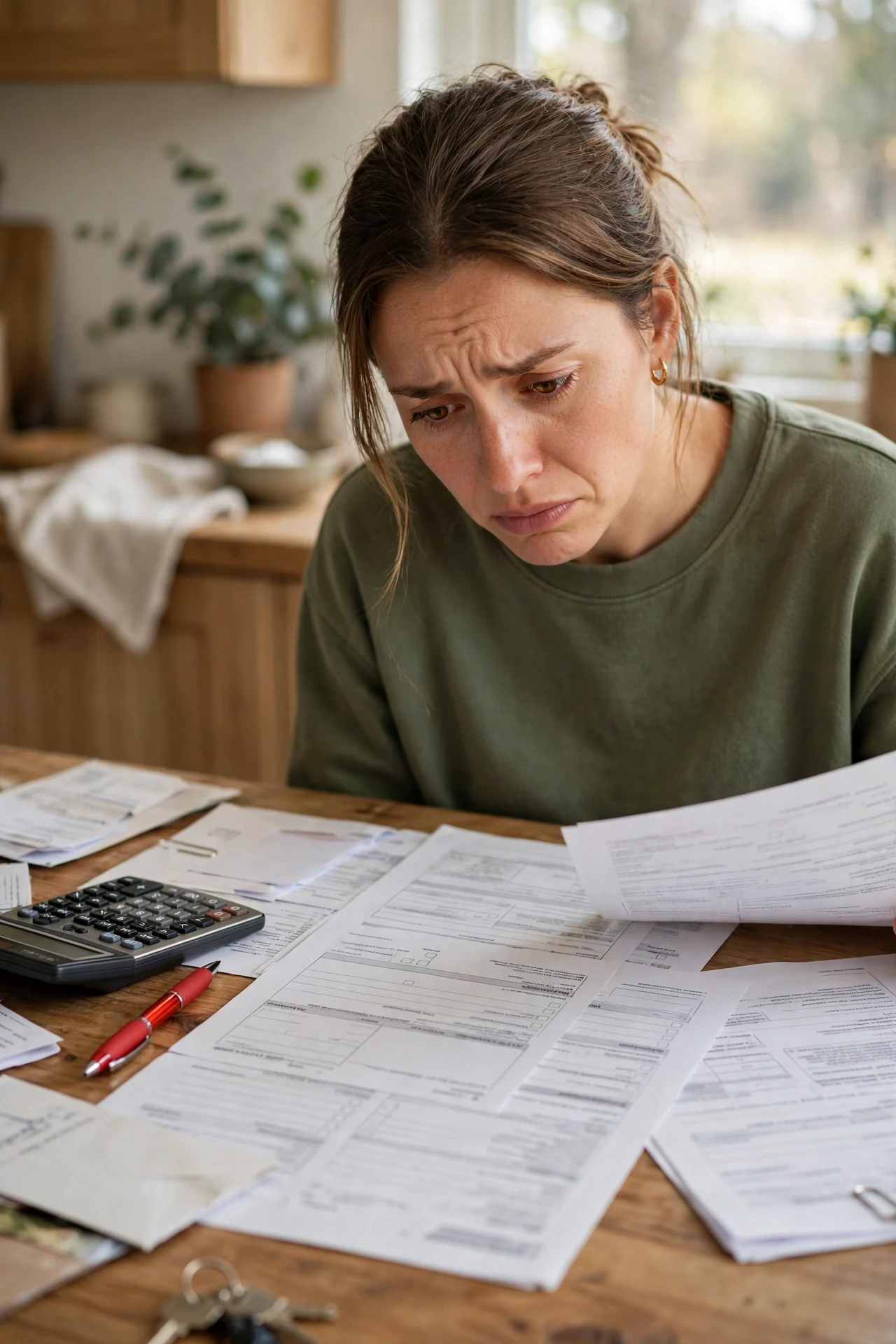
Overdraft fees hit the people with the least money the hardest — the average overdraft user pays over $250 a year in fees. The system punishes being broke, which is quite the business model.
- Switch to a bank or credit union with zero monthly fees and free ATMs
- Turn on low-balance alerts so your phone warns you before fees strike
- Turn OFF overdraft “protection” — a declined card embarrasses you for free; overdraft costs $35
- Use your own bank’s ATMs or get cash back at the register
IMO, switching banks feels like a huge chore and takes about 20 minutes. Your laziness costs you $250 a year. Do the math on that hourly rate.
6. Buying Cheap and Buying Twice
A $20 pair of shoes dies in four months. An $80 pair lasts four years. The cheap shoes cost you $240 over four years; the good ones cost $80. Being broke is expensive — the less money you have, the more the cheap stuff costs you.

This trap hits everything: tools that snap, pans that warp, phone chargers that fray in a week. You save $30 today and spend $90 replacing the thing twice.
- Calculate cost-per-use: price divided by how many times you will actually use it
- Buy quality on items you use daily — shoes, mattress, cookware, winter coat
- Buy cheap on trends and things kids will destroy anyway
- Read the 2-star reviews before you buy; they tell the truth the 5-stars hide
Spending more upfront often costs less overall. It feels wrong. The math does not care about your feelings.
7. Auto-Renewals and Zombie Free Trials
Free trials convert to paid plans at 3am on a Tuesday, silently, while you sleep. The gym membership you used in January keeps billing in October. That domain name for the business idea you abandoned years ago? Still renewing.

Companies design the cancellation process like an escape room — signup took one click, cancellation takes a phone call, a chat agent named “Brad,” and your soul. They bet you will give up. Prove them wrong.
- Set a phone reminder for two days BEFORE every free trial ends
- Use a virtual or prepaid card for trials so charges bounce when the trial ends
- Search your inbox for “receipt,” “renewal,” and “billing” once a quarter
- Cancel the gym and pay per visit until you actually go twice a week for a month
People typically recover $25 to $60 a month here. The cancellation call takes ten minutes. That is a $300-an-hour activity. 🙂
8. “Treat Yourself” Spending on Bad Days
Bad day at work? Shopping cart. Argument with your partner? New shoes. Bored on a Sunday? Suddenly you own a waffle maker shaped like Texas.

Emotional spending feels amazing for about eleven minutes. Then the package arrives, the thrill evaporates, and your credit card statement reminds you that feelings cost 24% APR. Retail therapy treats the symptom and bills you for the cure.
- Use the 48-hour rule: want it? Wait two days. Still want it? Buy it guilt-free
- Keep a “fun money” line in your budget so treats feel planned, not sneaky
- Build a free comfort list: a walk, a bath, calling a friend, rewatching your show
- Unsubscribe from store emails — you cannot miss a sale you never see
Feelings deserve comfort. They do not deserve a maxed-out credit card. Spend on joy, not on coping.
The Honest Bottom Line
Let us do the scary math together. Plug even half these leaks and you keep roughly $150 to $300 a month. That is $1,800 to $3,600 a year — from money you already earn. No side hustle required. No ramen diet. Just fewer invisible holes.
Do not try to fix all eight this week. Pick the ONE leak that made you wince while reading. Fix that one. Then pick the next. Small plugs, big boat.
So — which leak is draining you right now? Be honest. Your bank account already knows the answer.