
The Christmas Budget Checklist: 10 Things to Set Before You Spend a Dollar

Last December, I bought my brother-in-law a $60 hot dog roller. He doesn’t even like hot dogs. That’s the kind of purchase that happens when you shop without a plan, and it’s exactly why I now sit down with a Christmas budget checklist before I buy anything.
This Christmas budget checklist fixes that problem. It covers ten decisions you make before you open a single shopping tab. Do them in order, and December gets a lot quieter.

Why Set Anything Before You Spend?
Most people start with the fun part. They scroll, they see a deal, they buy, and they add it all up in January when the credit card statement arrives. Sound familiar? That order guarantees surprises, and the surprises are never good ones.
A plan made first gives every purchase a boundary. You stop asking, “Can I afford this?” and start asking, “Does this fit the number I already set?” That shift sounds small, but it changes everything about how you shop.
Besides, you don’t need a finance degree. You need a notebook, a spreadsheet, or a notes app, plus a bit of honesty about what you can actually spend. The rest is just decisions, one at a time.
The 10-Item Christmas Budget Checklist
1. Set Your Total Number
Start with one figure: the most you’ll spend on the whole season. Not per gift, and not “around a few hundred.” Pick a real number.
Base it on what you can actually pay without borrowing from February. Look at your last two months of income and expenses, subtract your bills and savings goals, and see what’s left. If the number feels too small, shrink the plan, not the math.
My first Christmas budget came out to $400, and I laughed out loud. That number felt tiny, but it forced me to pick cheaper gifts, skip the fancy wrapping paper, and say no to a $90 Secret Santa gift exchange. The holidays still worked out fine.

2. Decide Where the Money Comes From
A budget without a funding source is a wish. Choose where the cash will come from before you spend a dollar.
Your realistic options:
- A dedicated savings account you’ve fed since summer (the dream scenario)
- Extra income, like overtime, a side gig, or selling stuff you don’t use
- Your regular monthly cash flow, if you trim other categories to make room
Notice what’s missing? “Put it on the card and figure it out later.” That’s not a source. That’s a loan with a bow on it.

3. Write the Full Gift List
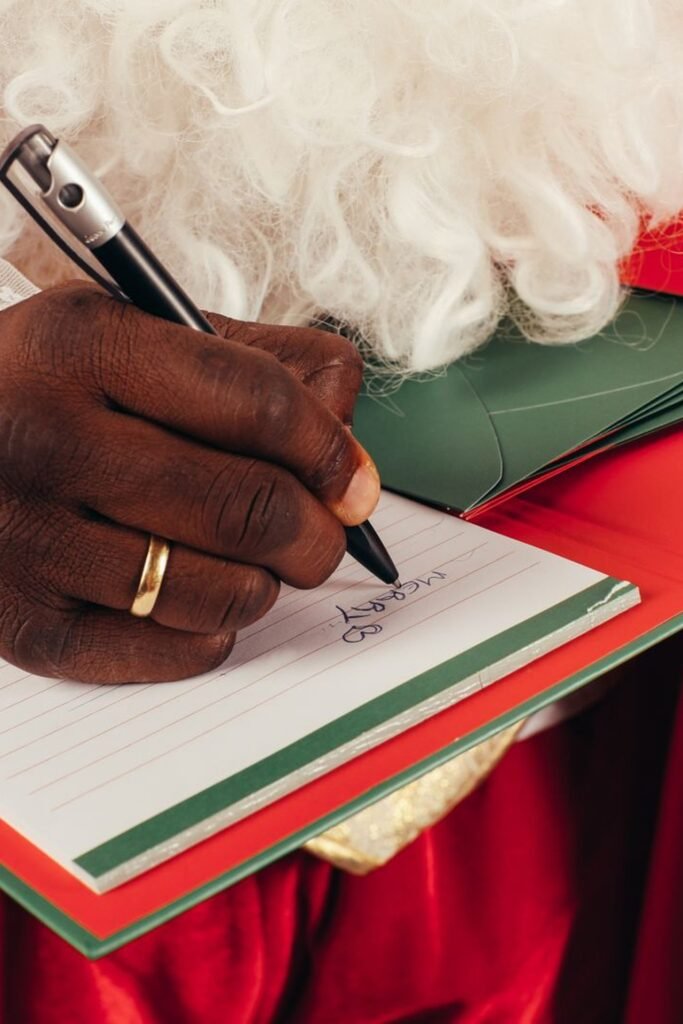
Grab your notebook and write down every person you plan to buy for. Include the teacher, the mail carrier, the coworker you draw in the office swap, and the neighbor who always brings cookies.
Most people forget at least three names. Those forgotten names show up on December 22nd, and you panic-buy something overpriced at the nearest store. A complete list now prevents expensive surprises later.
4. Assign a Limit to Each Person
Next to each name, write a dollar amount. Your spouse gets more than your cousin’s new boyfriend, and that’s fine. Nobody hands out ribbons for equal spending.
Add up the limits and compare them to your total from step one. Does the math work? If not, trim a few amounts or cut a few names. IMO, cutting names hurts less than carrying debt until spring.

5. Count the Non-Gift Costs
Gifts are only part of the bill. The rest sneaks in quietly and takes a big bite.
Here’s what to price out:
- Food and drinks for hosting or potlucks
- Travel, including gas, flights, or a pet sitter
- Decorations, a tree, and lights
- Wrapping paper, tape, and gift bags
- Cards and postage
- Party outfits and event tickets
Last year, my “tiny” food budget for a family dinner tripled because I forgot the drinks, the dessert, and the paper plates. Never again.

6. Account for Hidden Costs
Shipping fees, sales tax, return postage, and expedited delivery all add up. A $25 gift can quietly become a $40 gift once you add those extras.
Add a rough 8–10% to your gift totals to cover these extras. FYI, “free shipping over $50” often tempts you to buy $20 of junk you don’t need. It doesn’t save money. It spends it.

7. Build a Buffer
Something will go wrong. A friend will host a last-minute gathering, a package will arrive broken, or you’ll remember a forgotten cousin on December 20th.
Set aside 10% of your total as a buffer.
If you don’t touch it, congratulations: you just saved money. If you do use it, you planned for the mess instead of letting the mess plan for you.

8. Pick a Tracking Method
A budget you never check is a decoration. Choose one tracking method and stick with it.
Here’s how the common options compare:
- Spreadsheet: Great for people who like formulas and color-coding. It takes setup time but gives you total control.
- Budgeting app: Great for automatic updates. You’ll need to trust the app with your data, and some charge monthly fees.
- Paper notebook: Great for simplicity. It’s low-tech, but you can’t lose it to a software update.
- Cash envelopes: Great for overspenders. When the envelope’s empty, you’re done, and nobody argues with an empty envelope.
I use a basic spreadsheet with three columns: person, limit, actual. It takes thirty seconds to update after each purchase, and it keeps me honest when the sales emails start rolling in.

9. Write Your Impulse-Buy Rules
Retailers spend millions designing sales to override your brain. Fight back with rules you write while you’re calm, not while you’re staring at a 50% off banner.
A few that work:
- The 24-hour rule: Anything not on your list waits a day before you buy it.
- The swap rule: If you want to spend more on one person, you cut another person’s limit.
- The “who’s it for?” rule: If you can’t name the recipient, put the item down.
Can you really resist a doorbuster deal? Maybe not every time. But a rule gives you a speed bump, and a speed bump is often enough to stop a bad purchase.

10. Set a Stop Date
Pick a day when shopping ends. For most people, that’s December 18th or 20th, depending on shipping times and your local stores.
A stop date does two things. It cuts the panic-spending that happens in the final 48 hours, and it gives you time to wrap, rest, and actually enjoy the holiday.
You can’t overspend on a day you’ve already declared “done.”

Cash, Debit, or Credit: Which Should You Use?
This question starts arguments at family dinners, so let me give you my honest take.
- Cash: Easiest to control, since you physically see it shrink. It’s awkward for online shopping and offers no fraud protection.
- Debit: Pulls from your real balance, so you can’t spend money you don’t have. Fraud protection is weaker than credit, though.
- Credit: Offers rewards and stronger buyer protection. It also tempts you to spend beyond your limit, and interest charges wipe out any rewards fast.
My opinion? Use debit or cash for most gifts, and use credit only if you pay the full balance in January. That way you get the protection without the interest hangover.

Common Christmas Budget Mistakes (I’ve Made Most of Them)
Even with a checklist, a few traps catch people every year.
Treating Sales as Savings
A 40% discount on something you didn’t plan to buy isn’t a deal. It’s a $60 purchase you wouldn’t have made otherwise, and the store knows it.
Real savings only happen when you buy something already on your list.
Forgetting Your Own Wants
You’ll probably buy something for yourself, so plan for it. A small “me” line in your budget, maybe $20 to $30, stops the guilt spiral. Budget for it honestly instead of hiding it in someone else’s gift total.
Skipping the Conversation
Many families stress over spending because nobody talks about it. Have you ever suggested a price cap with your siblings or a gift swap instead of buying for everyone? That one conversation can save each person hundreds of dollars.
Ignoring January
Christmas ends, but the bills don’t. Before you finalize your plan, picture your bank account on January 15th. If that picture makes you nervous, your budget is too big. Scale it back now, while you still can.
How to Use This Checklist Right Now
You don’t need to finish all ten steps tonight. But do steps 1 through 4 before you buy anything else. Those four give you your total, your funding, your list, and your limits, which cover the biggest risks.
Then spend a second sitting on steps 5 through 7, which add the hidden costs and the safety net. Finish with 8 through 10 to build habits that protect you when the sales emails start piling up.
Final Thoughts
A Christmas budget doesn’t kill the magic. It protects it. You’ll still give thoughtful gifts, host the big dinner, and wrap too many presents at midnight, but you’ll do it without dreading the credit card statement.
Run through this Christmas budget checklist before you spend a dollar, and you’ll walk into December with a plan instead of a prayer. As for my brother-in-law, he’s still got that hot dog roller. I’m still not sure why. This year, he’s getting a gift card, and I’ve got the receipt logged in my spreadsheet.